Posted on: March 15th, 2026 by St. Stephens Downsview
The fourth Sunday in Lent marks a significant point: This Sunday, traditionally referred to as Mothering Sunday, offers us a moment to catch our breath before embracing the final intense stretch towards the cross and ultimately, the empty tomb.
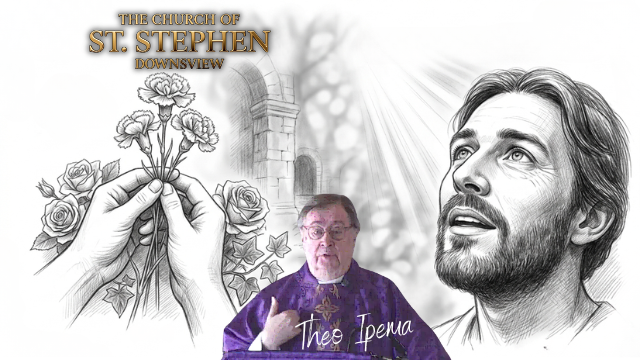
Interestingly, this day also came to be known as Mothering Sunday. While its origins are somewhat obscure, it became a day dedicated to recognizing our mothers. Revered customs emerged, like visiting one’s mother or honoring her memory through carnations—white if she had passed and red if she’s alive. Although these traditions signify respect and love for mothers, they were born outside the official liturgical texts.
Liturgical Changes and Their Impact
The liturgy’s evolution over time brought about changes that obscured the foundations of certain traditions. As a result, some fervently hold onto practices that have lost their meaning while discarding those with lasting significance. This shift led to the renaming of Palm Sunday, which became Passion Sunday—a change I deeply disagree with. I believe that while traditions like Mothering Sunday may fade, we should preserve the meaningful designations of Passion and Palm Sunday, focusing on the Gospel’s message.
The Gospel’s Revelation: Beyond Tradition
In the Gospel of John, we glimpse Jesus’ revelation to a Christian community of their time. Through the stories, such as the Samaritan woman at the well and the healing of a man born blind, we witness profound messages about seeing, believing, and light. Encountering a blind man, Jesus demonstrated extraordinary compassion in a notably public manner, even under tension.
A Life Transformed by Faith
This man, who met Jesus during a moment of danger and hostility, experienced a miraculous transformation. Believing is intertwined with seeing, and this man’s newfound faith reshaped his identity. His life, once shadowed by darkness, now illuminated by faith, became a testament to living under God’s light. For me, this narrative offers a powerful illustration of transformation brought by encountering Christ.
New Life Through Baptism
The story reminds us of our own spiritual rebirth. In the Gospel, Jesus uses clay—forged from the earth itself—to heal. This symbolic act points us to our own baptism as a moment of becoming a new creation in Christ, much like the first human from the biblical narrative. Anointed and set apart, our lives should manifest the light of Christ.
Concluding Reflections: Living as Children of Light
Especially during Lent, we must remain vigilant, reflective on aspects of our lives that shrink from light. We are called to reject darkness and embrace a living faith that illuminates through goodness, righteousness, and truth. This ongoing conversion is celebrated in our liturgical expressions, as we join with the heavenly hosts in worship.
In reflecting on these traditions and the rich narratives of the Gospel, may we always remember to seek the light in our lives, living out our faith with renewed purpose and strength.
Posted on: March 8th, 2026 by St. Stephens Downsview
I have never heard anyone say, “I wish my life were more complicated.” For most of us, the opposite is true. We expend energy trimming the undergrowth that has overgrown our lives to make them less complicated. This approach also applies to our spiritual lives…
We are tempted to narrow the focus and limit religious experience to one issue or idea. This tendency is especially pronounced during Lent, when our attentions are focused on sin and forgiveness. However, it is essential to step back and reflect on the freedom that is ours through the gospel and the difference God’s grace and love make in our lives.
The Love of God Through the Gospel
In our gospel today from the fourth chapter of John, we have a vivid example of this encounter between Jesus and the Samaritan woman at Jacob’s well. The gospel comes and sets her free, and the results for her life are earth-shattering. It is a story about God’s love for you and me and the difference that makes in our lives.
Misconceptions of Faith
Unfortunately, remnants of old beliefs still exist in the Christian consciousness. You can encounter this when people respond to a fatal illness by saying, “Oh, well, it’s God’s will.” They seem to think that this ready acceptance shows bravery, but it often reflects an eastern fatalism rather than understanding God’s will as love, grace, and mercy.
The Heart of the Universe: Unconditional Love
If the cross teaches us nothing more, it surely shows that at the heart of the universe there is a heart beating full of love. Unconditional love, love that will not let us go, as the old hymn puts it. That is precisely the love Christ shows—the same love of God demonstrated in the parable of the Prodigal Son.
The truth is God is not a tyrant out to get us. Christ brings us the living water of grace and mercy and peace. His love goes all the way to the cross, ensuring that wayward individuals like the woman of Samaria and all of us prodigals are loved into the newness of life that is the gospel. This is the good news: God loves you and me, that woman at the well, and all God’s people.
Acceptance and Grace
Christ accepted the Samaritan woman just as she was—unconditional grace and love. The first song many of us learned in Sunday school was, “Jesus Loves Me, This I Know, For the Bible Tells Me So.” That is what Christ conveyed to that woman at the well—not a rebuke or an exhortation but gracious love. This love gave her a sense of self-worth and hope she had never experienced before.
Our Worth and Mission
We must keep before us the idea that Jesus’ coming, and the cross we focus on during this Lenten season, show us that in God’s eyes we are truly worth saving. If we have no worth, as some doom peddlers suggest, then God in Christ went to a lot of trouble for nothing. But the truth, as stated by Peter, is that “you are a chosen race, a royal priesthood, a holy nation, God’s own people.”
Witnessing to the Gospel
That understanding leads us to grasp what is at the heart of our calling and the prime mission of the church: to witness the gospel. We are saved by a loving Father, set free to spread the good news of God’s love in Christ. Just as the Samaritan woman did in her hometown, we are commissioned by Christ to be his witnesses.
The Church’s Role
We, as the church, are the body of Christ, challenged to be channels of God’s love and grace for others and instruments of His peace. There is an urgent need for us to demonstrate what grace and the Christian life truly mean. The healthy church is out in the world, helping, healing, and liberating people in the name of Jesus. That is the kind of church we must strive to be, and that is the mission we must be about.