
Walk the Path of Repentance and Peace
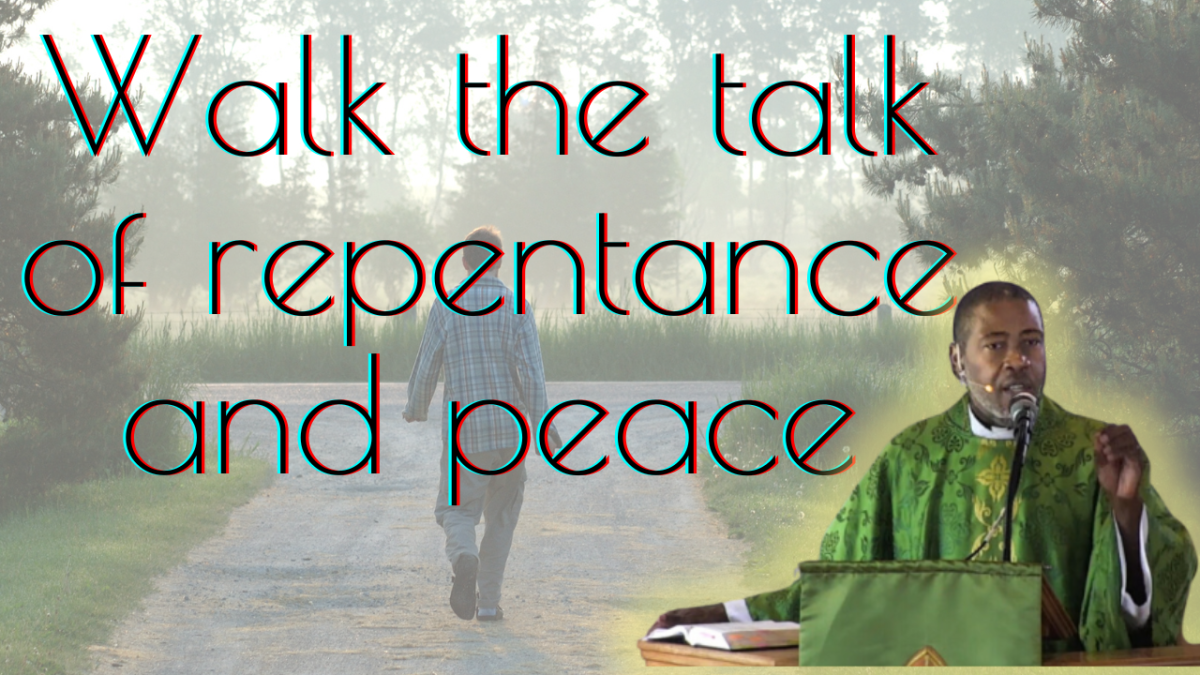 Luke tells us that John went into all the region around the Jordan, proclaiming a baptism of repentance for the forgiveness of sin. As it is written in the book of the words of the prophet Isaiah, the voice of one crying out in the wilderness, prepare the way of the Lord, make his paths straight.
Over the last year and about two months, the world’s attention has been captivated by what are perhaps the two major conflicts of the world. The war between Russia and Ukraine, and the war between the Israeli government and Hamas. The reality is that neither of these wars started in this generation. Their roots, originating from that original offense, go back for many generations. Some nations and people have been fighting for so long that they probably can’t even remember what they were really fighting for anymore. We just know that we are at war.
It takes real effort to remember an offense over many generations because it requires intentionality in holding a grudge. It requires intentionality to hand on unforgiveness, to teach those coming after us what those who have gone before us have done, in a way that engenders a desire for vengeance, even against their descendants. You didn’t do me anything, but your father’s father’s father’s father’s father did, and so you’re going to bear the brunt.
Transforming Our Path
Where does it all end? How do we stop this moving train? Or at least, how do we change its course or direction? While it may be easy for us to ask such questions about external wars, it is much more challenging for us as the people of God to address the questions of such wars which rage within us. That is the internal struggle over whether we strive to walk more and more in the light of Christ and in communion and fellowship with his body, the church, or whether we continue to try to do things our own way, on our own terms in this life, and to try to go it alone. Because that’s the war that rages within each and every one of us.
The Challenge of Identity
It is both ironic and devastatingly sad that many nations and peoples continue to fight, even to this day, against other nations. They’ve invested so much in the cause—so much into this conflict—that stopping feels impossible. The conflict has become such an integral part of their identity that they would find it very difficult to even recognize themselves if they just stopped fighting. This is who we are. Similarly, I would venture to say that we find it extremely difficult to change the course of our lives because we feel that we have gone so far down a particular road.
Our lives and our identity have been shaped by the unfortunate choices and decisions that we have made along the way, forming a kind of home for ourselves. Leaving that home or recognizing who we really are if we were to live more like the way Christ calls us is a difficult task. But yet, friends, that is precisely what repentance calls us to do.
The Call to Repent
In repentance, there is a change of heart, a change of mind with regard to the choices that we have made or the things that we have done, and therefore a change in the direction in which our life is headed. That’s what repentance means. There is authentic godly sorrow over our past deeds because in that moment of repentance, we recognize and acknowledge that God’s way was always right and that it is we who have strayed. From that moment of repentance, we endeavor in the grace of God and with the power of the Holy Spirit to continue along God’s way and not our own.
The Pathway to Peace
Repentance is stopping right in our tracks—and turning back towards the light, turning back towards God. Walking towards the light that is Christ’s life, it is in this act of repentance, stopping, acknowledging, turning, and walking towards God that we begin to experience the peace that Christ brings. God’s peace goes to the root of our conflict. It goes to the heart of our sin. It begins with truth-telling, and this truth-telling must often work through conflict to establish a true and authentic peace.
Conclusion
Perhaps the place to begin in identifying those things of which we need to repent is by giving careful attention to those areas of our lives where we do not presently experience God’s peace. As you consider who you are and where you are in the light, where is that groaning in your life? Where is that heaviness? Where’s that sense of unease? Where’s that sense maybe of complacency in the midst of the darkness?
God never called us to be peacekeepers. God calls us to be peacemakers. And making peace is by no means easy work, but it is important work. It is gospel work. It is the path of peace. It is our salvation.